Welcome to everyone who arrived from Facebook. This is the complete story, uncut, just like we promised.
The road smelled like pine trees and bad decisions.
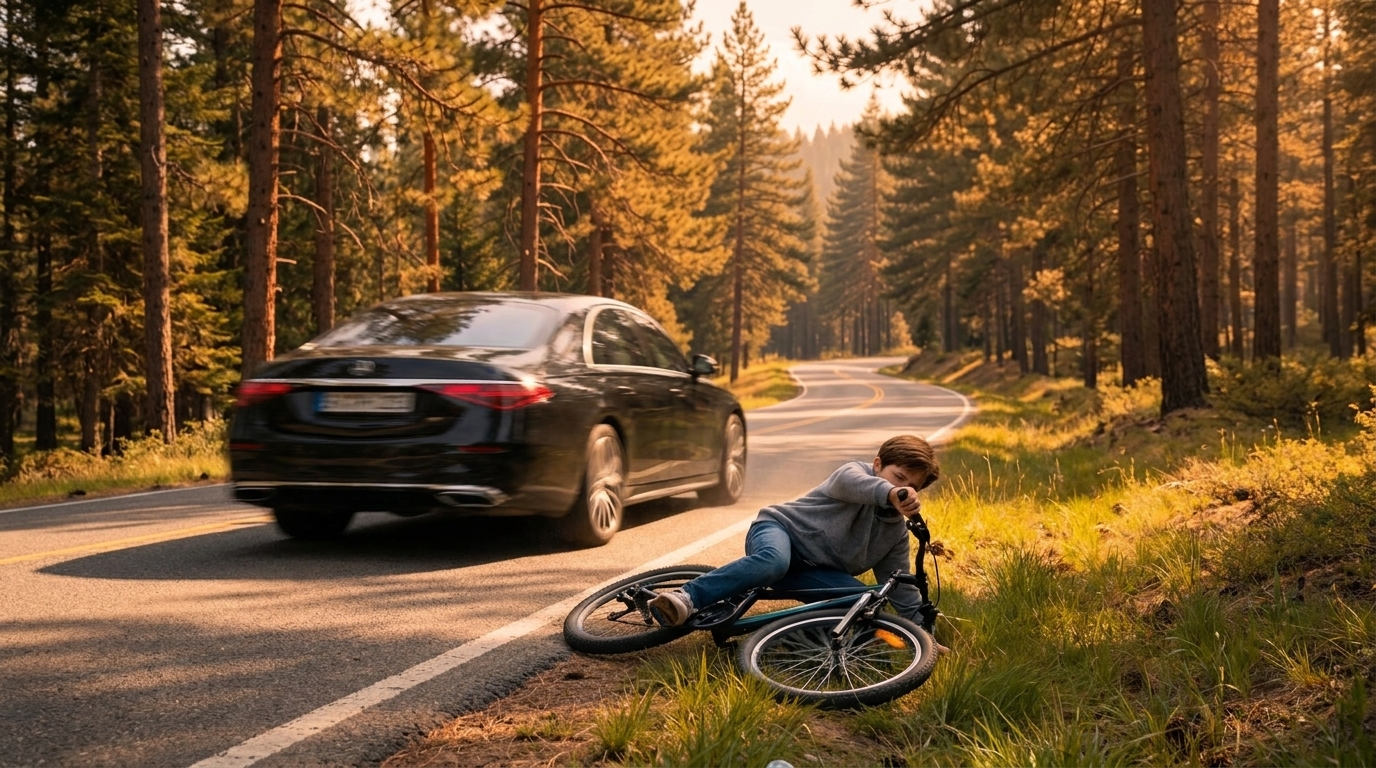
Not that Mr. Kane noticed either of those things as he drove that morning. He rarely noticed things that didn’t directly concern him. It was one of his defining characteristics. The ability to move through spaces and situations and people without registering anything that didn’t serve an immediate purpose.
It had made him successful in certain ways.
It had also made him the kind of person who drives too fast on a winding mountain road because slowing down had always been someone else’s problem.
The Boy on the Bicycle
His name was James.
Eleven years old. Short dark hair. The grey hoodie he wore almost every day because it had been a gift from his father during a trip they had taken together two years earlier and because some things you wear not because they’re the most comfortable option but because wearing them is a way of carrying something with you that you don’t want to put down.
James had been riding that road since he was eight.
He knew every curve. Every patch where the gravel got loose near the shoulder. Every point where the pine trees grew close enough to the edge that you had to stay toward the center of the lane because the shadows made it harder for drivers coming around the curve to see you until they were already too close.
He had been riding carefully that morning.
Which is why he was still alive when the Mercedes came around the curve.
The Thirty Seconds That Changed Everything
Kane hadn’t seen him until the last possible moment.
Not because the visibility was bad. Not because the conditions were difficult. But because Kane had been looking at his phone. A message from his assistant about a meeting that afternoon that he was already considering canceling because the people involved in the meeting had not been performing at the level he expected and he was in the mood to let them know that in person.
He had looked up from the phone exactly in time to swerve.
Not enough to avoid the boy completely. Enough to avoid hitting him directly.
The Mercedes clipped the edge of the bicycle’s rear wheel as it passed.
The boy went down onto the grassy shoulder with the bicycle on top of him.
Kane stopped the car.
Not because he was concerned. Because stopping was the calculated response. Driving away from something like that on a road with security cameras that he hadn’t fully registered yet would have created complications he didn’t want.
He opened the door.
Leaned out.
Looked at the boy on the grass.
— Then stay off the road kid.
What Kane Didn’t Know About James
James’s father was a man named Richard Harlow.
Richard Harlow was fifty three years old and had spent thirty years building something that most people in his industry considered impossible which was why most people in his industry had stopped trying to build it and why Richard had been able to build it without the kind of competition that would have made it harder.
He ran a private security and intelligence firm that operated in fourteen countries.
His clients were the kind of people whose names you recognized from the news but whose actual activities you would never read about in any news source because the actual activities of the people who hired Richard Harlow were precisely the kind of activities that required the services of someone like Richard Harlow.
He had forty seven operatives in the field at any given moment.
He had a team of six assigned permanently to his family.
James knew all of their names.
He had grown up around them. They had taught him chess and card games and the specific kind of patience that comes from spending time with people who understand that waiting is not the opposite of action but one of its most powerful forms.
When James raised his phone to his ear on that road he was not calling his father to ask for help in the way that Kane imagined when he said what he said with that smile.
He was sending a location signal that activated a response protocol that his father’s team had established years earlier for exactly this type of situation.
His father didn’t need to say anything.
The signal said everything.
The Four Minutes
Kane waited by the car for approximately four minutes after the boy made the call.
He had spent those four minutes in a state of amusement that he would later find difficult to explain to himself. An amusement that came from the absolute certainty that whatever was coming was manageable. That whatever a boy on a bicycle on a mountain road could call into existence by talking to his father was something that Kane had the resources and the connections and the history to handle without significant difficulty.
He had handled bigger things.
He told himself this during the four minutes.
He almost believed it.
The sound of the engines arrived before the vehicles were visible.
Kane heard them coming from both directions simultaneously which was when something in him registered for the first time that the situation might be operating according to a logic he hadn’t fully understood yet.
The four black SUVs appeared around the curves at both ends of the road at the same moment.
They stopped.
They formed a configuration around the Mercedes that blocked every possible direction of movement with a precision that was not accidental.
The doors opened.
The men who stepped out were the kind of men that Kane recognized immediately not from having met them personally but from knowing what their existence meant. He had hired men like these before. He knew what they cost. He knew what their presence in a situation communicated about the person who had sent them.
The lead operative walked toward the Mercedes.
He stopped six feet from Kane’s door.
— Step out of the vehicle Mr Kane.
Kane looked at the boy.
The boy was standing on the grass beside his broken bicycle with his hands in the front pocket of his grey hoodie watching the scene with the calm of someone who has seen this before. Not exactly this. But enough variations of this to understand how it worked and how it ended.
— Who is this kid?
The operative didn’t answer.
He didn’t need to.
What Happened Next
Kane stepped out of the vehicle.
He was asked to wait while certain things were verified. The manner in which this was communicated left no practical alternative to compliance.
He waited.
James sat on the grass near his broken bicycle and watched the pine trees on the other side of the road for a while. Then he took a granola bar out of the front pocket of his hoodie and ate it methodically while one of the operatives examined the bicycle to assess the damage.
Richard Harlow arrived twenty two minutes after the signal.
He came in a single vehicle. No additional security. He didn’t need it.
He was a tall man with grey at his temples and the kind of stillness that some people develop after spending enough years in situations where stillness is the most important available tool.
He walked past Kane without looking at him.
Walked directly to James.
Looked at his son for a moment without saying anything.
Then he put his hand on the back of James’s head briefly in the specific gesture that James had known his entire life as the one his father used when he wanted to communicate something that he didn’t have words for in that moment.
James nodded.
Richard turned to look at Kane for the first time.
Kane began to say something.
Richard raised one hand slightly.
Kane stopped.
The Conversation
The conversation between Richard Harlow and Mr. Kane lasted eleven minutes.
Kane’s lawyers would later describe it as a conversation. Richard’s team would not describe it at all because they did not discuss their client’s private interactions with anyone who wasn’t their client.
What can be said is that by the end of those eleven minutes Kane understood several things he had not understood at the beginning of them.
He understood who James was.
He understood who Richard Harlow was.
He understood the specific way in which the events of that morning would be documented and the specific contexts in which that documentation could become relevant to various aspects of Kane’s professional and personal situation.
He understood that none of this was a threat.
It was information.
What he did with the information was his decision.
Richard Harlow was not in the business of making decisions for people.
He was in the business of making sure people had complete information before they made their own.
What James Remembered
James would think about that morning on Willow Road for years afterward.
Not because of Kane. Not because of the black SUVs or the operatives or the eleven minute conversation that he had been too far away to hear clearly.
He would think about the thirty seconds between when he stood up from the grass and when he raised the phone to his ear.
Thirty seconds during which he had looked at the man leaning out of the car door with that smile and had understood something that he hadn’t had words for at eleven but that he would find words for later.
That the people who move through the world treating other people as obstacles or inconveniences or things to be managed are not moving through a world where there are no consequences for that.
They are moving through a world where they haven’t encountered the consequences yet.
That morning on Willow Road Mr. Kane had encountered them.
In the form of a boy in a grey hoodie with a granola bar in his pocket and a father who answered on the first signal every single time.
What Changed
Kane sold the Mercedes three weeks later.
He told people it was because he wanted something more practical for mountain roads.
He also started looking up from his phone more often when he drove.
Small changes.
The kind that don’t make the news and don’t get documented anywhere and that most people around him probably never noticed.
But James’s father noticed.
Not because he was watching. He wasn’t.
Because thirty years of reading people had given Richard Harlow a reliable sense of which encounters produced that kind of small invisible change in a person and which ones didn’t.
The ones that did were the ones where the person had encountered something that genuinely shifted their understanding of the world they were moving through.
Not a punishment.
Not a lesson imposed from outside.
A moment of clarity.
The road on that particular Tuesday morning had produced one of those moments.
Richard considered that a reasonable outcome.
James considered it a reasonable outcome too.
Though he would have also accepted an apology.
The Moral
There is a specific kind of arrogance that develops in people who have moved through the world for long enough without encountering the full consequences of how they move through it.
It doesn’t feel like arrogance from the inside.
It feels like efficiency. Like realism. Like a practical understanding of how things work and who matters and who doesn’t in any given situation.
Mr. Kane had that kind of arrogance.
It had been useful to him in many situations.
On Willow Road on a Tuesday morning it had not been useful.
Because the fundamental error in that kind of arrogance is always the same.
It assumes that the information available in the first thirty seconds of any situation is complete. That what you can see tells you everything relevant about what is actually present. That the boy on the grass beside the broken bicycle is exactly and only what he appears to be and nothing more.
James was more.
He always had been.
The grey hoodie was just a grey hoodie.
But the person inside it was connected to forty seven operatives in fourteen countries and a father who answered on the first signal every single time.
The lesson is not that you should be careful because the person you’re dismissing might be powerful.
The lesson is that the dismissal itself is the problem.
Regardless of who the person turns out to be.
